

Thirteen years on – weather permitting, unlike the last scheduled appearance in 2019, when snow forced its cancellation – Passo Gavia is set to return to the Giro d’Italia. The climb has not featured in the race since 2014.
Gavia poses two major challenges: its altitude, at 2,618 metres, and the timing of Italy’s most prestigious professional cycling stage race, whose final week traditionally takes place in late May.
Up there, the road usually does not reopen to traffic until mid-June, sometimes even later.
The cursed climb
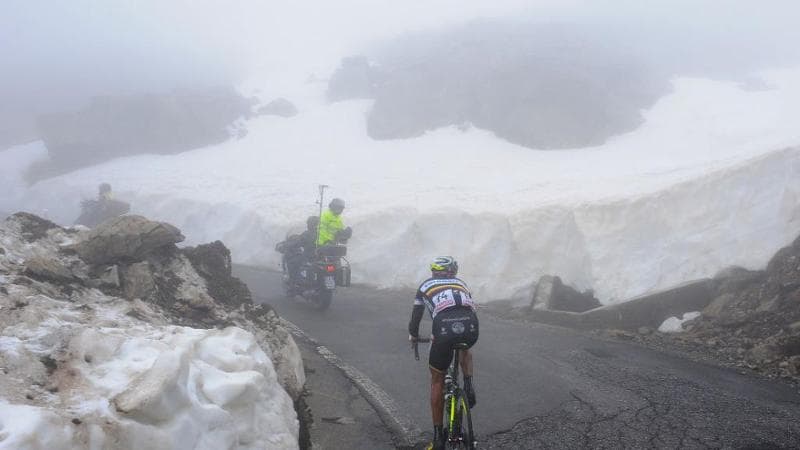
Snow, freezing cold and an especially hostile microclimate have caused countless problems over the years, both for riders tackling the climb between Valfurva and Val Camonica and, above all, for race organisers.
This persistent uncertainty has earned Gavia a reputation as the Giro’s cursed climb.
It is undoubtedly one of the toughest ascents in the race, with gradients reaching 16 per cent and a total length of 17 kilometres.
It is also one of the most spectacular – arguably the most breathtaking climb ever tackled by the Giro.
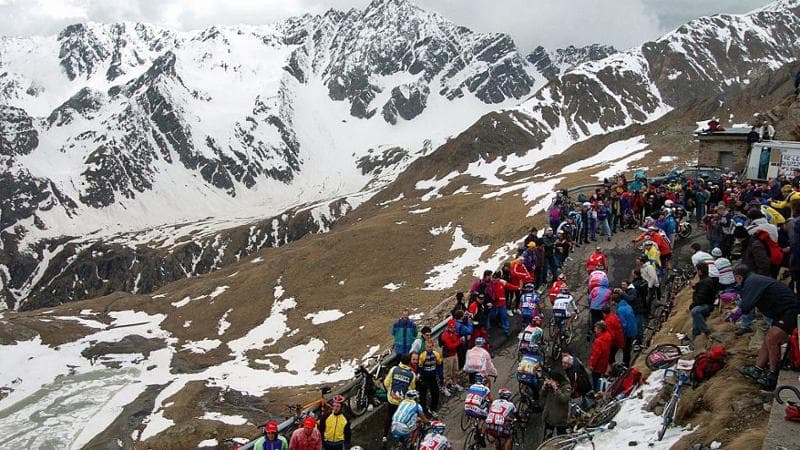
Gavia ’88
How could anyone forget what happened on Gavia in 1988?
A fierce snowstorm hit after the stage had already set off from Chiesa Valmalenco, leaving the organisers – the Giro was then directed by Vincenzo Torriani – with the unenviable decision of sending the riders into the unknown.
Dutchman Johan van der Velde launched an attack wearing the cyclamen jersey, with short sleeves and shorts. He made it over the summit and then, according to legend, took shelter in a mountain hut to warm up and get something to eat.
Many riders were forced to stop and hold their hands against the radiators of cars and motorbikes in the race convoy, while others had hot tea poured over their bodies.
Franco Chioccioli lost the pink jersey to American Andrew Hampsten, who went on to become the first American ever to win the Giro. The stage itself was won by Dutchman Erik Breukink.
It was a day destined to become part of Giro folklore, although it also sparked controversy that would linger for years.
As it happens, just 300 metres from the mountain pass lies a unique feature of the Italian landscape: the country’s only surviving patch of Arctic tundra, a relic of the last Ice Age.
Only one Italian has reached the summit first
Passo Gavia made its Giro d’Italia debut in 1960. The first rider over the summit was Imerio Massignan, who then suffered two punctures on the descent, allowing Luxembourg’s Charly Gaul to take the stage victory. At the time, much of the road was still unpaved; it was not fully surfaced until the 1990s.
The stage was first cancelled because of bad weather in 1961, and Gavia disappeared from the race route for almost three decades, until its return in 1988.
The following year, in 1989, the stage was cancelled again, as it was in 2013 and 2019.
Between 1996 and 2014, the climb featured in the race on eight occasions, almost always under threatening skies: rain mixed with snow was the best-case scenario.
The last rider to cross the summit of Gavia in the Giro was Colombia’s Robinson Chalapud.
The Gavia tragedy
In a curious twist, none of the riders who were first over the summit of Gavia ever went on to win the stage or the Giro – either in the edition in which they crossed the pass or in any other year.
It is another chapter in the mountain’s curse, although Gavia has also been the scene of a tragedy unrelated to cycling.
On 20 July 1954, a Fiat 639 military vehicle carrying 21 members of Italy’s Alpine troops, aged between 21 and 23, plunged down a ravine after the road surface gave way on the Brescia side of the pass. The vehicle fell approximately 150 metres. Seventeen men died at the scene, while one of the two most seriously injured soldiers succumbed to his injuries the following day.
In the past, the mountain pass was traversed in every season. But sudden changes in weather, thick fog, blizzards and avalanches eventually earned it a sinister nickname among locals: “Passo della Testa del Morto” – the Pass of the Dead Man’s Head.
This article was reviewed by an external translation partner