

There is no room for ambiguity on the departure boards at Milazzo. Just one word: “Cancelled.” In winter — and not only then — a journey to the Aeolian Islands aboard a high-speed ferry doesn’t begin when you buy your ticket. It begins when the sea decides to let you cross.
Sometimes it’s the sirocco, whipping up the waves. At other times, it’s the mistral, sweeping into the harbour. And suddenly, time takes on a different meaning. It is no longer measured by a quartz clock. “Early” and “late” become one and the same. Because everything depends on the weather. Or rather, on Aeolus, the god of the winds.
Whether you can get to Messina for a medical appointment. Whether you can reach Lipari at all. There is an unwritten rule here: live according to nature’s rhythms and accept that not everything is within your control. A kind of resignation that turns uncertainty into the very first stage of the journey.
When the summer tide of tourists recedes, the island returns to its original pace. Weekends are the exception, when islanders who work in Sicily or further afield return home, along with a few visitors travelling back and forth on high-speed ferries.
Marina Corta, a bustling waterfront during the warmer months, becomes a quiet seaside haven again. Fishing boats are hauled ashore onto the quay, safely out of reach of the winter storms. The murmur of conversation is confined to the handful of bars still open in the historic centre, while overhead there is only the wind, the clouds and the cries of seagulls.
A museum telling the Aeolian Islands’ story through the ages
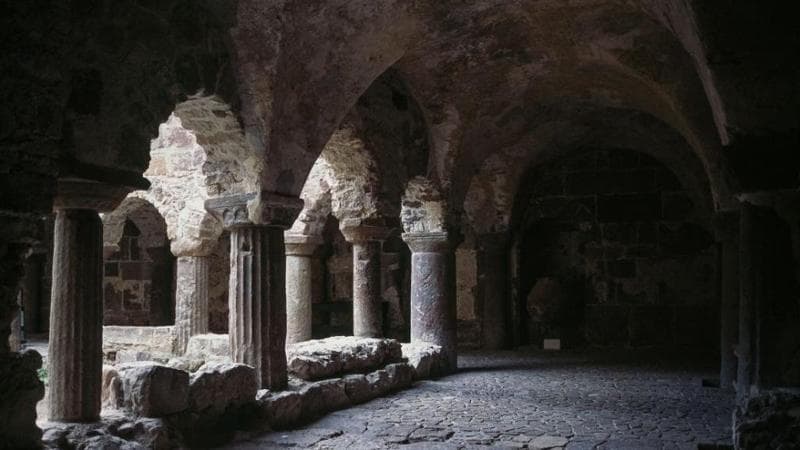
Climbing from Marina Corta towards the Castle on a rainy or windy day brings the island’s long history into sharp focus. Within its walls stands the Basilica of San Bartolomeo, reached by a long staircase cutting through the fortifications, with its Norman cloister tucked away behind a side entrance.
There is also the Luigi Bernabò Brea Archaeological Museum, home to an extraordinary collection that visitors can explore in complete solitude during winter, among ancient Greek masks and amphorae recovered from shipwrecks deep beneath the sea.
The museum has a distinctly old-fashioned charm, with its wooden and glass display cases and no augmented reality or special effects. Its appeal lies in the story it tells: that of an ancient civilisation and of the peoples who inhabited the Aeolian Islands without ever truly possessing them.
Experiencing all this in peace feels like a rare privilege. That heritage lives on in local traditions, kept alive by folk groups such as the Cantori Popolari delle Isole Eolie.
The island of political exile
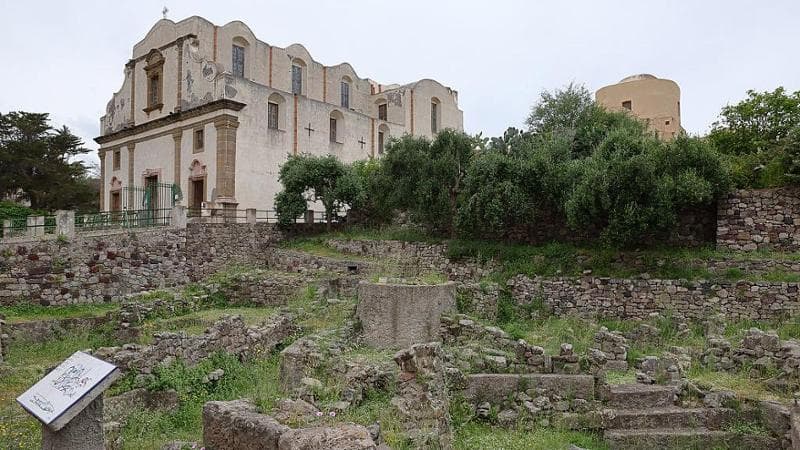
But the Castle is also a place of political and civic memory. During the Fascist era, it became one of Italy’s main centres of internal exile. Intellectuals and anti-Fascists including Carlo Rosselli, Emilio Lussu and Ferruccio Parri walked within these stone walls before their extraordinary escape by boat to France in 1929.
Looking out to sea from the battlements, imagining those nights of imprisonment and waiting, it becomes clear how Lipari was, for centuries, both a fortress and an open-air prison.
Inside the Castle, visitors can see the quarters where people banished from mainland Italy for refusing to submit to the ruling regime were housed.
But virtually the entire town of Lipari became a place of exile. Those sent to the island often had to find accommodation in rented or requisitioned houses and large communal rooms scattered throughout the town.
Plaques in the narrow streets commemorate those forced into exile on the island, including Curzio Malaparte and Edda Ciano, who was sent there after the fall of the Fascist regime.
Each location is marked by one of 50 ceramic tiles identifying former places of confinement. A web app, developed partly with funding from NextGenerationEU, allows visitors to discover them one by one and learn the stories of those who were forced to live there.
From pumice quarries to ancient thermal baths
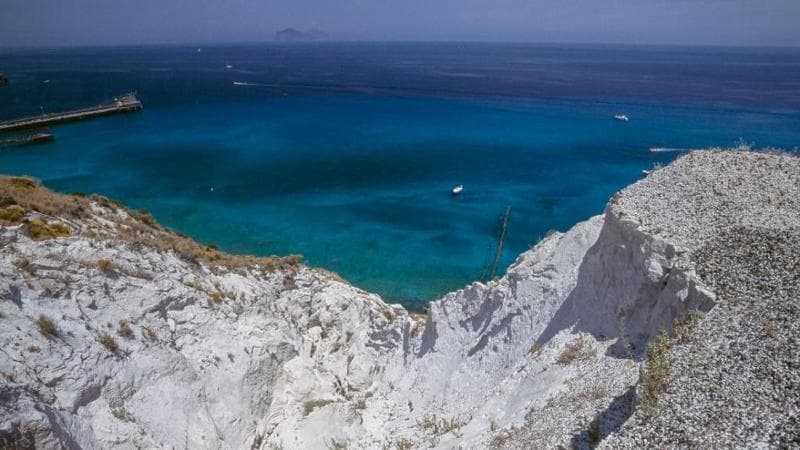
Beyond the town, Lipari in the off-season reveals its volcanic soul and a past shaped by more than the sea.
At Porticello, the former pumice quarries offer a striking glimpse of the Aeolian Islands’ industrial heritage. Rusting structures and old piers stretch into the Tyrrhenian Sea, while a mountain of white “snow” meets the deep blue water.
Pumice has been extracted on Lipari for centuries. But it was only in the 20th century, with the introduction of a structured industrial plan, that quarrying became a significant part of the island’s economy.
Lipari pumice, prized for its remarkable whiteness and physical properties, has also been used in the clothing industry, particularly to give jeans a worn appearance.
Although the industry provided an important source of income for generations of islanders, inadequate safety measures and exposure to silica caused respiratory illnesses, including silicosis, among many workers over the decades.
Towards Quattropani, the land still bears signs of its volcanic past. The trail through the Kaolin Quarries winds between rocks shimmering with golden and violet hues before reaching the vapours rising from sulphurous fumaroles.
Not far away, the tholos-shaped dome of the ancient Terme di San Calogero bears witness to a tradition of thermal bathing dating all the way back to the Mycenaean period.
The baths have long been closed to the public, but the site remains an essential stop for understanding the profound relationship between people and the geology of this remarkable landscape.
A taste of Malvasia
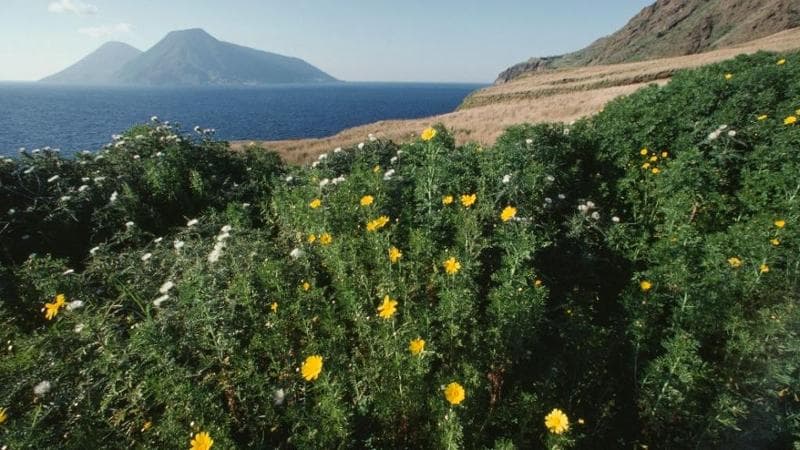
Away from the coast, several wineries produce Malvasia. Not simply a sweet dessert wine, but also a dry, complex wine that captures the aromas of volcanic soil and the salty sea air. Among them is Tenuta di Castellaro, perched on a hill that drops almost sheer towards the sea, with views across to Salina. The estate, which produces some of the island’s finest Malvasia, also boasts a striking underground cellar where barrels are stored and tastings featuring local produce are held.
Capers, pulses and fish: the flavours of the Aeolian Islands
It’s only a short step from wine to food. In winter, many local dishes feature pulses and salt-preserved capers. And, of course, there is excellent fresh local fish.
Then there are traditional Christmas sweets, although they can actually be found throughout the year, such as nacatole: filled biscuits intricately decorated to resemble crocheted lace.
For a complete introduction to Aeolian flavours, just below the Castle stands the historic and celebrated Filippino restaurant, an ideal place to discover traditional island cuisine with a contemporary twist.
Discovering Lipari’s sister islands
From Lipari, weather permitting, it is easy to reach its neighbouring islands. One of the experiences recommended by Lonely Planet in its Best in Travel 2027 is to explore them by sailing boat.
Vulcano, with its natural sulphurous thermal baths; Salina, with its elegance and cliffs plunging into the sea; Stromboli, with its slightly precarious air.
Each is different, yet all share extraordinary beauty and the slow rhythm of island life, when the tourist season ends and another way of living begins.
The journey home will once again involve negotiating with the sea. But after seeing Lipari when the spotlight fades, even waiting for a ferry that never arrives ceases to be a problem.
It becomes, quite simply, part of life.
This article was reviewed by an external translation partner