

ROME — “I bought a painting by Ewa Juszkiewicz at an auction. When I brought it to Rome, even Valentino was struck by it.
He loved modern art, but was harder hard to please when it came to contemporary art. Yet he liked that painting.”
The historic headquarters in Piazza Mignanelli
In the rooms of the former Propaganda Fide school in Rome, which later became the headquarters of the Valentino fashion house in Piazza Mignanelli, Giancarlo Giammetti tells the story behind Aura.
Giammetti, Valentino’s longtime partner in the designer’s extraordinary creative journey, also co-founded PM23 with him. The foundation was established to manage Valentino’s archives and promote social and cultural projects celebrating the fashion house’s legacy.
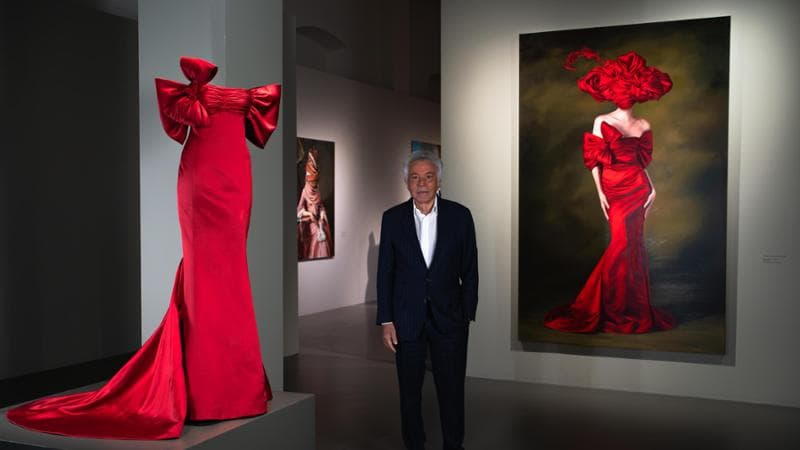
Aura marks PM23’s third venture into the art world, following its debut with Rosso and then Venus, which explored the relationship between Valentino’s designs and works by Portuguese artist Joana Vasconcelos.
Running from 17 October until 21 February 2027, Aura is the first exhibition conceived since Valentino Garavani’s death in January. It also reinforces a longstanding goal: bringing the languages of art and fashion together to continue exploring femininity.
Avoiding the wax museum effect
“The danger when displaying clothes is that the result can look a little like a wax museum,” Giammetti explains. “Instead, we wanted — and still want — Valentino’s dresses to engage in a dialogue with works of art, to spark questions.”
And what could provoke more questions than a woman’s face hidden from view, as in the portraits painted by Polish artist Ewa Juszkiewicz?
As visitors move through the rooms of Palazzo Mignanelli, their gaze shifts between garments from the Valentino archives and Juszkiewicz’s canvases.
Drawing on 18th- and 19th-century portraiture
In her series of tributes to earlier painters, Juszkiewicz deliberately draws on the traditions of 18th- and 19th-century portraiture, only to turn them on their head.
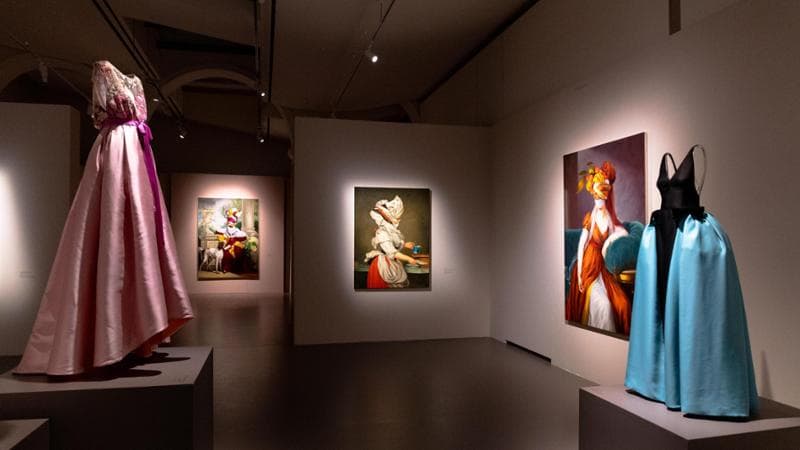
In works ranging from In a Shady Valley, Near a Running Water (after François Gérard) to Untitled (After Jan Adam Kruseman), and from Lady with a Mirror (after Élisabeth Vigée Le Brun) to Untitled (after Joseph Wright), she painstakingly recreates clothing, furnishings, landscapes and pets in dazzling colours, remaining remarkably faithful to the visual language of the originals.
But this meticulous attention to historical detail sets the stage for a radical departure: the woman’s face is concealed beneath folds of fabric, ribbons or hair. These coverings obscure her identity yet, paradoxically, reveal something about her.
The hidden conventions of realism
“Studying 18th-century painting and Neoclassicism, I became aware of the conventions concealed within that realism, of the constant idealisation of women,” Juszkiewicz explains.
“The faces are really like masks: the same eyes, the same expressions, the same delicate oval shape.”
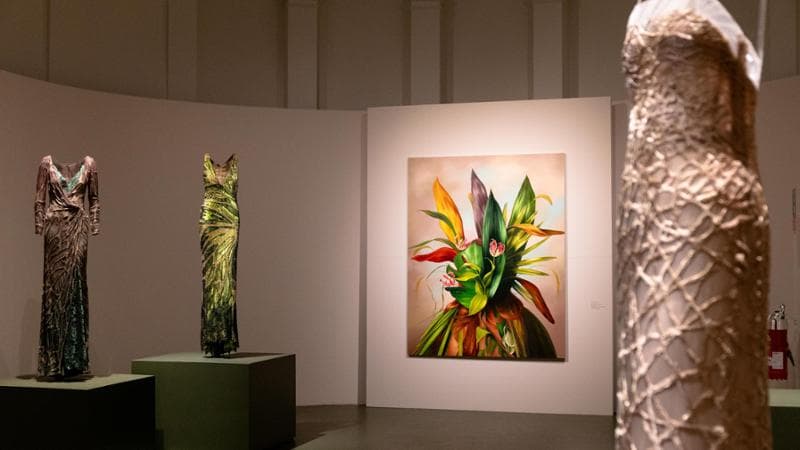
Paradoxically, individuality emerges “through what people wear, through shapes and craftsmanship”.
This is where her work meets haute couture: in the importance of materials, their expressive power and the constant reinvention of the elements of a symbolic language.
A lesson in fashion history
The Valentino haute couture pieces displayed in Aura offer a masterclass in fashion history. One dress, in the house’s signature red, has even become the centrepiece of a site-specific work by Juszkiewicz.
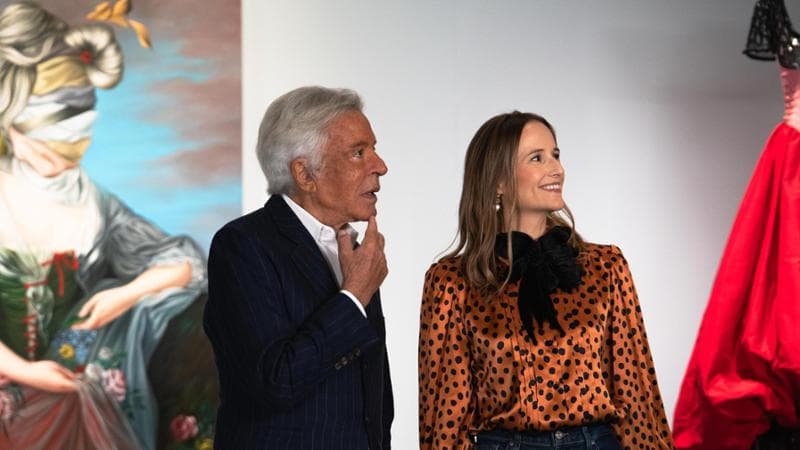
Bustiers, bias cuts and bare shoulders reveal just how thoroughly Garavani knew the history of couture and its codes.
But he also knew how to recombine them, capturing the transformations of femininity. From the 1960s through the 1980s and into the 2000s, he celebrated women with bodies.
And faces.
“Color, for me, is an emotional need”: inside the Roman home of Valentino’s architect
Cesare Cunaccia
This article was reviewed by an external translation partner